
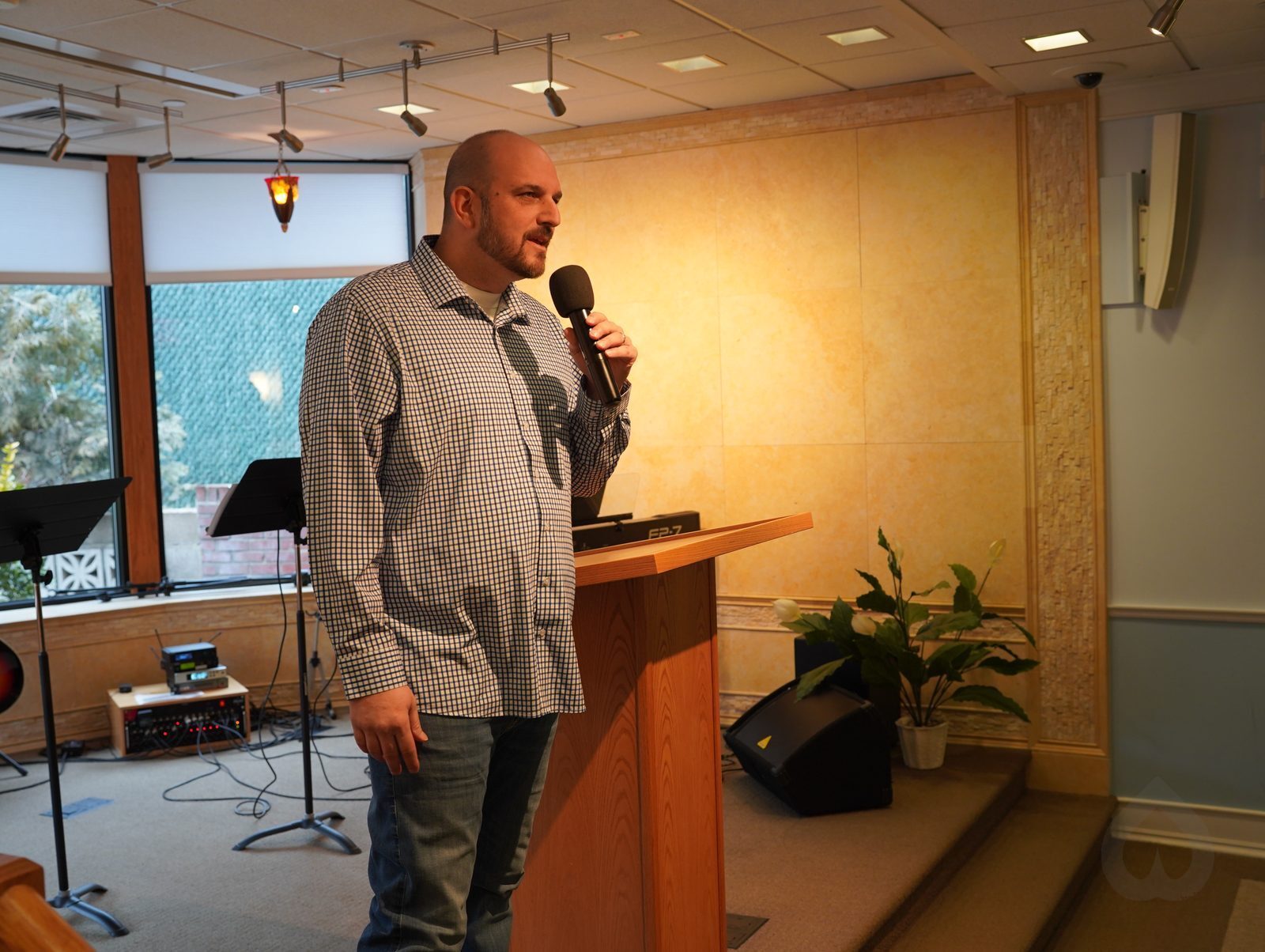
A prophet steps into the room and the first thing he does is call the whole earth to court. Not the neighborhood. Not the nation. The earth. And then, before the hearing is over, he takes off his shoes, tears his clothes, and starts howling like an animal.
That is Micah 1. It opens like a courtroom and it ends like a funeral, and the man doing the preaching is the one crying hardest.
We started a new series through Micah this Sunday at Calvary Life Brooklyn, and chapter one is heavy on purpose. It is a chapter about God as Judge. But the sentence everything else hangs on is a small one in verse three, and most people read straight past it: before God can judge, He has to leave somewhere. He has to come out of His place.
Which raises the question the whole chapter turns on. If judgment means God has to step out of where He normally is — where, exactly, does He normally sit?
“Hear, all you peoples! Listen, O earth, and all that is in it! Let the Lord God be a witness against you, The Lord from His holy temple. For behold, the Lord is coming out of His place; He will come down And tread on the high places of the earth. The mountains will melt under Him, And the valleys will split Like wax before the fire, Like waters poured down a steep place.”
— Micah 1:2–4 (NKJV)
Who was Micah, and when did he preach?
Micah was a prophet from Moresheth, a small town in the Judean countryside, who preached during the reigns of Jotham, Ahaz, and Hezekiah (Micah 1:1). He was a contemporary of Isaiah and Hosea, but he had a different pulpit. They spoke to the political center. Micah spoke to ordinary people in the rural south — and his name itself is a question: who is like the Lord?
That matters more than it sounds. Micah's name is not a label, it is the question his whole book exists to answer. Every chapter hands back a different picture of God: the Judge who steps out of His place, the Shepherd who gathers, the Ruler who comes out of Bethlehem, and at the very end the God who pardons iniquity and delights in mercy (Micah 7:18). Chapter one gives you the first answer, and it is the hardest one. Do not stop there. A coin has two sides, and staring at one your whole life does not make the other side disappear.
The kings tell you what he was preaching into. Jotham "was twenty-five years old when he became king, and he reigned sixteen years in Jerusalem," and he "did what was right in the sight of the Lord" — and yet the chronicler adds, "But still the people acted corruptly" (2 Chronicles 27:1–2, NKJV). A good king was not enough. Ahaz was worse. Hezekiah brought reform. And through all three, Micah preached the same message, because the need underneath never changed and it was never fundamentally political.
That is worth saying plainly in an election-soaked city. Governments change. What does not change is whether you actually know God. Revival never starts at the top; it starts with the least of us, with the people nobody is watching.
What does it mean that “the Lord is coming out of His place”?
It means judgment is not where God lives. "Coming out of His place" is not about geography — God is everywhere. It is about character. His settled position is the mercy seat. To act as Judge, He steps off a throne of mercy and grace onto ground He does not naturally occupy. Judgment is a trip He takes, not an address He keeps.
Scripture is specific about where that place is. When God gave the pattern for the tabernacle, He said: "And there I will meet with you, and I will speak with you from above the mercy seat, from between the two cherubim which are on the ark of the Testimony" (Exodus 25:22, NKJV). That is the meeting place. That is the seat.
The New Testament says the same thing to us in plain terms: "Let us therefore come boldly to the throne of grace, that we may obtain mercy and find grace to help in time of need" (Hebrews 4:16, NKJV). Mercy is withholding what you actually deserve. Grace is giving you what you never earned. That combination is God's normal posture toward you.
Anyone raised in a house with rules already understands the picture. Don't make me get up. When a parent has to leave their chair, the outcome is never the good version. Micah 1:3 is that sentence with infinite weight behind it. God is being asked to get up.
And when He does, verse four says the mountains melt like wax and the valleys split like water down a slope. Everything the nation trusted to be permanent turns liquid. Some of us are living inside that already — the thing we were certain would hold, the arrangement we thought would never come apart, and it came apart anyway. Psalm 24:3 asks it exactly: "Who may ascend into the hill of the Lord? Or who may stand in His holy place?" (NKJV). Under God, nothing we built holds its own shape.
Why does God name Samaria and Jerusalem as the sin?
Because both cities were built to gather God's people around Him, and both had become the reason His people were scattered. Micah asks his own question and answers it: "What is the transgression of Jacob? Is it not Samaria? And what are the high places of Judah? Are they not Jerusalem?" (Micah 1:5, NKJV). The capital was supposed to be the cure. It became the disease.
Samaria was the capital the northern tribes built after the kingdom split. That split is the wound underneath the whole indictment. There was meant to be one place of worship, one gathering, one people — and instead there were two centers, two altars, two versions of who God was.
Division is not a small sin in this chapter. It is the named one. And it still happens the same way: somebody decides they do not like the church, so instead of staying in a room where they can be disagreed with, they build a platform where they are the only judge of their own opinions. Community requires accountability. That is the cost, and it is also the point. God did not call us to a room by ourselves; He called us into a family — which, like every family, will occasionally be a mess.
Then comes the sentence. God says He will pour Samaria's stones into the valley and uncover her foundations, and that everything she was paid for her unfaithfulness will burn (Micah 1:6–7). Samaria sat proudly on a hill; the judgment reverses the geography of her pride. Whatever you built as a substitute for God — the thing you go to for peace, the thing you buy when you are empty — God is willing to take it down. Not because He is cruel. Because He wants you back, and the substitute was never going to get you there.
Why does Micah weep instead of pointing a finger?
Because he is not above the judgment, he is inside it. Micah 1:8 turns the whole chapter: "Therefore I will wail and howl, I will go stripped and naked; I will make a wailing like the jackals And a mourning like the ostriches" (NKJV). He does not announce the funeral from a safe distance. He puts on the mourner's clothes before anyone else does.
This is the credential no school issues. Micah is not asking Israel to feel anything he refuses to feel first. And he is showing them something true about God, because this grief is not Micah's invention — it is God's heart. God is not pleased when someone chases sin and their life falls apart. He wished they had turned. "For her wounds are incurable," Micah says, "For it has come to Judah; It has come to the gate of My people" (Micah 1:9, NKJV). It started in the north and it has arrived at the southern gate. Sin never respects the line you drew around your own house.
There is a hard word in verse ten: "Tell it not in Gath" (NKJV). Gath was Philistine territory, and Micah's town sat near that border. Do not hand your collapse to people looking for a reason to dismiss God. That is not about hiding failure — it is about who gets to narrate it.
The honest version is not pretending to be perfect. It is being transparent. When we sin against someone who does not believe, the most powerful thing a Christian can do is go back and say: I misrepresented God, I was wrong, will you forgive me? Not self-righteousness. Not performance. Just an honest account of a standard we did not meet and a Savior who took it anyway.
What do the small-town names in Micah 1:10–16 mean?
Micah walks a line of villages and turns each name into its own sentence. Beth Aphrah means "house of dust" — so, roll in the dust. Shaphir means "beautiful" — so, pass by in shame. Achzib means "deceit" — so, the houses of Achzib will be a lie to the kings of Israel. He is playing on names of places he knew by heart.
Read quickly, it looks like a list. Read slowly, it is the most tender thing in the chapter. These are towns nobody in the capital could have found on a map. Micah names them anyway, one at a time, because they are his. God did not send a message about the important places only.
God knows your block, too. He knows the name of your neighborhood and what people mean when they say it. He is not interested only in the big rooms.
Two of these lines land especially close. "For the inhabitant of Maroth pined for good, But disaster came down from the Lord" (Micah 1:12, NKJV) — they wanted good things, and what came was not what they expected. Most of our anger at God is unmet expectation. We build a picture of how a thing is supposed to go, and when it does not go that way, we turn cold. But the expectation was never the promise. If our expectations are in direct conflict with God's will, being upset that they went unmet is being upset that God is God.
And "O inhabitant of Lachish, Harness the chariot to the swift steeds (She was the beginning of sin to the daughter of Zion)" (Micah 1:13, NKJV). Lachish was a military town — chariots, horses, hardware. The beginning of the sin was trusting something that was not God. There is a blank most of us keep filling in: if I just get ___, everything else will work out. The job. The relationship. The number on the scale. Nothing fills that blank. One thing has to be right, and everything else follows from it.
The chapter closes on a mother's grief — "Make yourself bald and cut off your hair, Because of your precious children" (Micah 1:16, NKJV) — the human cost sitting underneath the theology. And, said from a Brooklyn pulpit with a grin: I'm already there. Where are you? The point is real, though. Micah has stopped caring about the outside. He is finally worried about the inside.
What does Micah 1 actually ask of us?
It asks us to hear the warning as mercy. God comes out of His place only after mercy has been refused for a long time — which means every warning before that moment is grace. He warns, and warns again, because He knows exactly what we are made of. The chapter is not asking for fear. It is asking for one honest response to something He has already said.
So take one thing you have been warned about long enough. Not ten. One. And stop making Him say it again.
And do not walk away from chapter one thinking you have met God. You have met one side. The same book that opens with melting mountains ends like this: "Who is a God like You, Pardoning iniquity And passing over the transgression of the remnant of His heritage? He does not retain His anger forever, Because He delights in mercy" (Micah 7:18, NKJV). That is the answer to the question in the prophet's own name — and it is where this series is headed.
Key Scriptures Explained
| Reference | What it says | Why it matters here |
|---|---|---|
| Micah 1:2 (NKJV) | "Let the Lord God be a witness against you, The Lord from His holy temple." | The court is called and the whole earth is summoned. The sentence comes from a throne, not from a temper. |
| Micah 1:3 (NKJV) | "For behold, the Lord is coming out of His place; He will come down." | The hinge of the chapter. Judgment requires God to leave where He normally is — and where He normally is, is mercy. |
| Micah 1:5 (NKJV) | "What is the transgression of Jacob? Is it not Samaria?" | The capital built to gather the people became the thing that divided them. Division is the named sin. |
| Micah 1:8 (NKJV) | "Therefore I will wail and howl, I will go stripped and naked." | The prophet mourns instead of accusing. He models the grief God Himself feels over it. |
| Micah 1:13 (NKJV) | "She was the beginning of sin to the daughter of Zion." | Trusting anything other than God is where the trouble starts. Nothing else fills that blank. |
| Exodus 25:22 (NKJV) | "And there I will meet with you… from above the mercy seat." | Names the place God is coming out of in Micah 1:3. His settled seat is the mercy seat. |
| Hebrews 4:16 (NKJV) | "Let us therefore come boldly to the throne of grace." | The same seat, opened to us. Mercy withholds what we deserve; grace gives what we never earned. |
| Micah 7:18 (NKJV) | "Who is a God like You… Because He delights in mercy." | The book's own answer to the question in Micah's name. Chapter one is one side of the coin. |
Practical Application
- Name the one warning. Ask honestly what God has already said to you more than once. Write it down. Answer that one before asking for new direction.
- Check the blank. Finish the sentence "if I just get ___, everything will work out." Whatever fills it is the thing Micah 1:13 is talking about. Bring it to God by name rather than defending it.
- Audit your expectations. Where you are angry or cold toward God, ask whether the expectation you are grieving was ever actually His promise.
- Refuse the platform reflex. When something in the church frustrates you, stay in the room. Accountability is the cost of community and it is also the gift.
- Make one honest repair. If you misrepresented God to someone who does not believe, go back and say so. Transparency preaches louder than a clean record.
- Read the whole book. Do not build a picture of God out of one chapter. Read Micah straight through this week and watch the question in his name get answered.
A Prayer for This Week
Father, thank You for a book like Micah that lets us ask who is like our God. We confess that chapter one is heavy. You are Judge, and You are right to be. But even here You showed us that judgment is not where You live — that You had to come out of Your place to do it, and that Your place is a throne of grace and a seat of mercy.
Give us time to make the correction, and give us room to actually change. Show us the things we built up as substitutes for You, and help us not to fight You when You take them down. Where our expectations have quietly turned into accusations, forgive us. Where we have looked at everything except You, turn our eyes back.
You gave Your Son. You gave everything. All You ask is that we give You the same. In Jesus' name, amen.
Frequently Asked Questions
Does “the Lord is coming out of His place” mean God moves from one location to another?
No. God is everywhere; the language is about character, not coordinates. His settled place is the mercy seat (Exodus 25:22), the throne of grace we are told to approach boldly (Hebrews 4:16). "Coming out of His place" describes God stepping into the work of judgment, which is not His natural posture toward us.
Why is division treated as such a serious sin in Micah 1?
Because the two cities Micah names, Samaria and Jerusalem, were the centers of a kingdom that had split in two, with two rival places of worship. What was built to gather God's people around one God became the thing that scattered them (Micah 1:5). The same pattern shows up wherever people trade accountability for a platform.
Is Micah 1 only about ancient Israel, or does it apply now?
Both. The sentence fell on real cities in the eighth century BC. But the chapter's logic is not time-bound: God warns before He acts, warnings are mercy, and anything trusted in God's place eventually comes down. Micah's roll call of small towns also makes a point that travels — God is not interested only in the important places.
Why does Micah name so many obscure villages?
He is turning each name into a sentence about what is coming — Beth Aphrah, "house of dust," is told to roll in the dust; Achzib, "deceit," becomes a lie to the kings. Beyond the wordplay, it shows a prophet who knows these places personally. God does not deal only in capitals.
If chapter one is all judgment, where is the good news in Micah?
It is in the same book, and Micah puts it at the end: "Who is a God like You, Pardoning iniquity… Because He delights in mercy" (Micah 7:18, NKJV). Chapter one shows the Judge. The book closes with the God who pardons. Reading one without the other gives you half a picture.
Listen to the Full Message
The full teaching on Micah 1 — "He Comes Down" — is available here: Micah 1: He Comes Down. The rest of our teaching library, including the complete Micah series as it unfolds, is at calvary.nyc/media.
If this is your first time in one of the Minor Prophets with us, the previous series is a good companion read: Why a Prophet Ran From God: Mercy in Jonah 1. Jonah ran from God's mercy. Micah wept because his people would not receive it.

Posted in Micah Series
Posted in Micah, Micah 1, minor prophets, mercy, judgment, throne of grace, mercy seat, Verse by Verse, Brooklyn Church
Posted in Micah, Micah 1, minor prophets, mercy, judgment, throne of grace, mercy seat, Verse by Verse, Brooklyn Church
New here?
You're welcome at Calvary Life Brooklyn
We're a neighborhood church family in Marine Park, teaching straight through books of the Bible a passage at a time. No dress code, no test at the door - come exactly as you are.
Sundays at 10:00 AM · 1974 Coney Island Ave, Brooklyn, NY 11223 In person or online.
Recent
Would You Even Notice? Micah 3 and 4 Explained
September 27th, 2026
The Shepherd Doesn't Wait at the Fence: Micah 2 Explained
September 15th, 2026
Don't Make Him Get Up: Micah 1 Explained
September 7th, 2026
He Wept Over a Plant, Not a City: Jonah 4 Explained
September 7th, 2026
Eight Words That Changed a City: Jonah 3 Explained
September 3rd, 2026
Archive
2026
February
March
Do Good People Go to Heaven? What Romans 3 Really Says About Being Right With GodTired of Trying to Be “Good Enough”? Discover the Freedom of Faith: Romans 4How to Stand Firm When Life Falls Apart: Romans 5 for Everyday StrugglesDo I Really Have to Keep Sinning? Understanding Freedom in Christ from Romans 6Why Literal Interpretation Matters: Starting Matthew in a Skeptical Age - Matthew 1
April
May
September
2025
August
Jesus is Gentle and Lowly: How to Find True Rest for Your Soul (Matthew 11:28-30)Jesus Is Man: You are not Alone Jesus UnderstandsJesus Is God: Is Jesus a Good Teacher or Is He God? Honest Answers for SeekersJesus Is The Logos: Why That Changes EverythingJesus Is Savior: Why Religion Isn’t Enough and How Jesus Meets Every SeekerJesus Is Lion and Judge: Why We Can’t Ignore His AuthorityJESUS IS Servant King: How His Humility and Authority Shape Our Lives
September
JESUS IS: Feeling Lost, Empty, or Hopeless? Jesus Answers with ‘I AM’JESUS IS: Abide in the Vine, How to Live Fruitfully in ChristThe Power of God’s Word: Transform Lives in Brooklyn, NYSummer Events in Brooklyn: Community, Faith, and Transformation in Marine ParkWalking Justly: Lessons from Exodus 22–23How Exodus Teaches Us to Love Others: Exodus 20Discovering Your 'Before and After' with God: How Covenants Transform Lives: Exodus 23-24How Exodus Teaches Us to Love God: Exodus 20
October
Breaking Free: How to Living in God’s Power and Promise of Freedom. Exodus 20:1-2What Is True Worship? Insights from the Tabernacle: Exodus 25-27Journey to Wholeness: Moving from Salvation to Surrender: Exodus 19Embracing Your Priestly Identity in Everyday Life: Exodus 28-30Empowered by Grace: Understanding Our Purpose in Serving - Exodus 18Proximity Without Intimacy: Are You Really Walking With God? - Exodus 32
November
Walking Under God's Provision: Daily Bread and Genuine Faith": Exodus 16From Wandering to Worship: The Road Back to God - Exodus 33The Road Forward: BEING Transformed by GOD: Exodus 34Worship Beyond the Pew: Living a Life of Praise: Exodus 15How a Willing Heart Completes God’s Work in Brooklyn: Exodus 35-39Beyond the Lyrics: How Worship Transforms Our Hardened Hearts: Exodus 7-9
December
Are You Ready to Move from Salvation to Service?: Exodus 40When God Strikes at Our Idols: A Reflective Journey Through Pharaoh’s Story: Exodus 10Overcoming Hurdles While Serving: Serving God with Faith and Courage: Exodus 5-6Finding Purpose in the Wilderness: Exodus 2-3Overcoming Spiritual Hurdles to Serve: Exodus 4Raising Leaders in Faith: Timeless Teachings for a New Generation: 1 Timothy Overview
No Comments